Options for Rebuilding Muscle Like My Mum & Dad
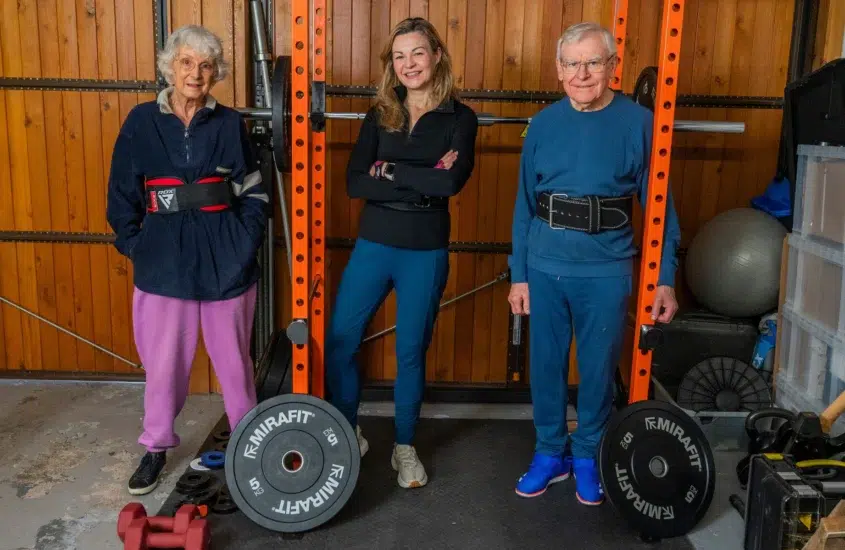
If you’ve been following our Rebuilding Mum & Dad series, you’ll know my parents have shown something many people still believe isn’t possible: you can rebuild muscle — and therefore strength, balance and mobility — at any age.
My mum and dad, both in their 80s, train with me twice a week in my garage using a barbell and weights. Since sharing their progress, I’ve been flooded with questions from people wanting to help their own parents (or themselves) get started.
This article brings together the clearest, most practical answers to those questions, drawing on expert advice shared on the channel — and what I’ve learned first‑hand training with my parents.
Why Building Muscle Matters So Much As We Age
Muscle isn’t just about looking toned or lifting heavier things. Muscle behaves more like an organ than a simple tissue — it plays a critical role in metabolic health, balance, bone strength and independence.
Loss of muscle with age (sarcopenia) is strongly linked to frailty, falls, loss of independence and poorer health outcomes overall. The good news is that muscle responds to training at any age — if it’s challenged properly.
That challenge is called progressive loading: gradually increasing resistance over time so the body has a reason to adapt and grow stronger.
Why We Use a Barbell
Let’s start with barbell training — and why we chose it.
A barbell allows you to train all the major muscle groups efficiently using compound movements. These are exercises that work several muscle groups at once. The four we use in our strength training regimen are:
- Squat
- Deadlift
- Bench press
- Overhead press
The big advantage of a barbell is it allows for very gradual but consistent progression. You can:
- Start very light
- Add weight gradually (often as little as 0.5–1 kg at a time)
- Progress consistently week to week
That ability to make small, steady increases is key — especially for older adults.
Gradual progression is exactly what has driven such dramatic gains in strength for both my parents.
This is why barbell training is considered one of the most efficient and evidence‑based ways to rebuild muscle.
Expert Options for Getting Started
Barbells aren’t the only way to build strength — and they’re not right for everyone — but for those who are interested, there are several ways to begin:
- Training in a specialist strength gym
- Strength coaching by a PT in a regular gym
- Online coaching with video feedback
- In-person strength coaching at home
- Small group training
- Short‑term coaching to learn technique, followed by independent training
Safe form matters — especially when lifting heavier loads — so some element of coaching to begin with at least is recommended.
Why Training Together Makes Such a Difference
One reason my parents have been so consistent is simple: we train together.
Training with others:
- Improves safety
- Increases accountability
- Makes people far more likely to stick with it
When you know someone else is showing up, you’re less likely to skip sessions.
It’s also a practical way to share costs if you’re paying for coaching or equipment.
Getting Started With Minimal Equipment
Not everyone can afford a barbell, weights or gym membership — and that shouldn’t stop anyone from building strength.
A key principle applies no matter what equipment you’re using:
The resistance has to increase over time.
That can be achieved with:
- Dumbbells
- Resistance bands
- Kettlebells
- Bodyweight (if exercises are progressed appropriately)
You can make exercises harder by:
- Adding weight
- Slowing the tempo
- Increasing range of motion
- Changing leverage (for example, elevated feet or single‑leg work)
- Increasing the number of repetitions
Building Strength at Home
Certain movements are especially valuable for maintaining strength and independence.
The squat
Often called the king of exercises, the squat works:
- Legs and hips
- Core
- Back and posture muscles
It directly translates to everyday tasks: standing up, sitting down, climbing stairs, getting out of a chair.
A simple home‑based strength routine might include:
- Squats
- Hinges (like hip hinges or deadlifts with weights or household items)
- Push movements (wall push‑ups, floor push‑ups, overhead presses)
- Pull movements (rows with bands or weights)
No Gym? No Problem
If someone has no access to equipment, meaningful strength work is still possible.
Examples include:
- Sit‑to‑stands from a chair
- Wall or counter push‑ups
- Step‑ups on stairs
What matters is choosing movements that are challenging enough and repeating them consistently, gradually adding sets and reps over time.
How to Choose a Strength Coach
Finding the right coach – whether you see them in person or online – is one of the most important steps — especially for older adults.
Here’s what to look for.
1. They prioritise progressive strength training
A good coach understands that muscle is built by gradually increasing resistance, not by endless random workouts.
Be cautious if someone:
- Avoids adding weight altogether
- Only prescribes very light exercises indefinitely
- Focuses solely on balance or stretching with no strength progression
- OR starts heavy. Older people should be starting out by lifting lighter weights and gradually increasing load.
Balance and mobility matter — but they improve most reliably when strength improves.
2. They are experienced training older adults
Ask:
- Do you have experience of working with people in their 60s, 70s or 80s?
- How do you adapt training for joint issues or health conditions?
A good coach will be thoughtful and methodical.
3. They care about technique
Safe technique is important. However, strength training doesn’t require perfection to be effective.
A strong coach:
- Teaches good form
- Progresses cautiously
- Adjusts when something doesn’t feel right
4. They welcome questions
You or your parents should feel comfortable asking:
- Why a particular exercise is being used
- How progress will be measured
- What the long‑term plan looks like
Looking Ahead
For people who are very frail or have limited mobility, I’ll soon be sharing on the channel guidance from a physiotherapist specialising in safe, home‑based strength and mobility work.
We’ll also continue to document my parents’ progress through Rebuilding Mum & Dad — showing what’s possible with the right approach, patience and consistency.
If you’re helping a parent get started — or starting yourself — I hope this gives you clarity, confidence and a realistic roadmap forward.
Strength changes everything.