Why I Stopped Botox at 53 — And Switched to a Home Laser Instead
Around two years ago, I stopped having Botox.
Instead, I started using a handheld home laser device designed to treat skin — and, for me, it’s now winning out over Botox.
That might sound… unlikely.
Because Botox works by freezing muscle movement, instantly smoothing out wrinkles — and this doesn’t do that at all.
But after using it consistently for several months, I realised something:
My frown lines were soft enough that I didn’t feel I needed Botox anymore.
In this article, I’ll explain:
- The best home laser device for skin – contrasting the NIRA with the DermRays
- What at-home laser treatments can and can’t do
- Whether they’re a realistic alternative to Botox
My Botox Background
I’m 53 now, and I first started having Botox around age 47 — just in my frown lines.
I’d typically have it done every 9–10 months.
Why not more often?
- I didn’t love the feeling of a frozen forehead
- I’m naturally expressive — and I want my face to reflect that
- While Botox has a strong safety record, I prefer to minimise unnecessary injectables
- And as someone who champions muscle strength as we age, I don’t love the idea of weakening muscle — even in the face
So I’d wait until my frown lines became more noticeable — that deeper, slightly “permanent scowl” look — before going again.
I assumed I’d just continue like this long term.
But then I revisited home laser.
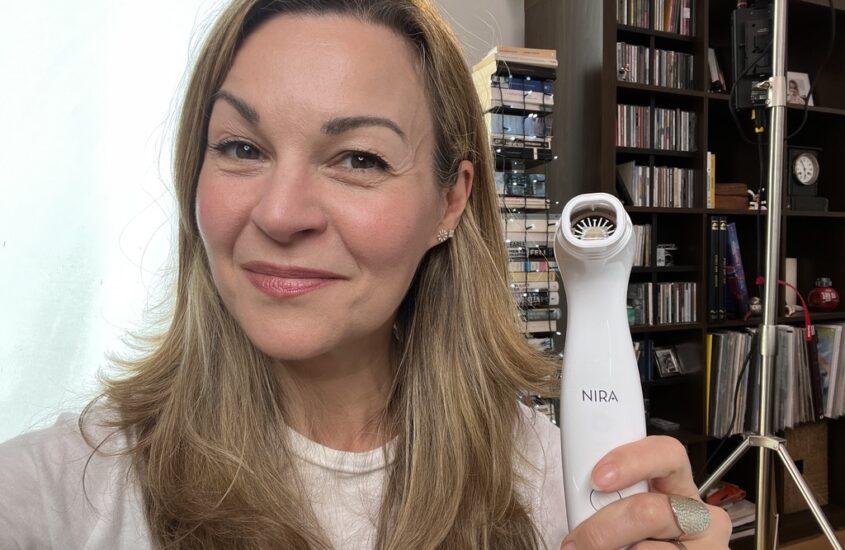
The Device I Use: Nira Pro
The device I use is the Nira Pro — a handheld, non-ablative laser.
I’ve tested several Nira skin laser models before, and while I saw some improvement, the results faded when I stopped using it.
So I didn’t stick with it.
That changed after I interviewed Nira’s creator, David Bean.
He described using the device like a “workout for your skin” — and I liked the sound of that.
So when the newer version came out (now the Nira Pro 3), I decided to commit to using it every other day, long term.
How At-Home Laser Works (In Simple Terms)
The Nira is a non-ablative laser, meaning it doesn’t damage the surface of your skin.
Instead, it delivers controlled heat just below the surface.
What it does:
- Targets water in the skin, not melanin
- Penetrates to around 1mm depth (not deep enough to affect fat)
- Triggers a cell stress response
- Stimulates heat shock proteins, which promote repair
- Leads to increased collagen production over time
Does It Actually Work?
One reason I’ve always taken Nira more seriously than many at-home devices:
It’s one of a relatively small number with published clinical data behind it, specifically on wrinkle reduction around the eyes.
My Results After Stopping Botox
The last time I had Botox was May 2024.
Normally, by around 10 months later, I’d be ready to go again.
But this time, I’d been using the Nira consistently for a couple of months — and results typically start appearing around 8–12 weeks.
And something changed.
- My forehead lines looked slightly improved
- But more importantly — I stopped noticing my frown lines
So I didn’t go back for Botox.
And I’ve continued using the laser ever since.
What Happened When I Tried DermRays?
Towards the end of 2025, I tested another at-home laser, the DermRays Revive.
On paper, it seemed more advanced:
- Faster coverage
- Plug-in design (no charging)
- Robust feel
- Strong cooling system
But my experience was very different.
What I noticed:
- It felt sharper and more intense (especially near eyebrows)
- My skin became noticeably drier within days
- After 8 weeks, my frown lines actually looked deeper
This may have been due to dehydration — but either way, it didn’t suit my skin.
There were also usability issues:
- The sensor didn’t always register properly on my forehead
- I struggled to get consistent contact in key areas
So while I’ve seen other reviewers report good results with DermRays, it didn’t work out for me.
When I switched back to Nira within around 6 weeks, I stopped noticing my frown lines again and that’s why it’s now a fixed part of my routine
Cost Comparison: Nira vs Botox
These devices aren’t cheap:
- Nira Pro 3: ~£510 / $560
- Nira Pro (second generation): ~£441
- DermRays: ~$699 (~£525)
But compare that to Botox:
- Typically £200+ per treatment
- Repeated every 6–12 months
👉 Over time, a device can work out more cost-effective
Can At-Home Laser Replace Botox?
No — not in a like-for-like way.
Botox:
- Stops muscle movement
- Smooths wrinkles quickly
Home laser:
- Does not stop movement
- Gradually reduces the appearance and depth of lines
- Works over months, not days
What At-Home Laser Can and Can’t Do
It can:
- Soften fine lines
- Reduce the appearance of deeper wrinkles
- Support collagen production over time
It can’t:
- Lift the face
- Tighten loose skin significantly
- Replace more invasive treatments
- Deliver instant results
The Most Important Factor: Consistency
Home laser is subtle, gradual, and entirely dependent on how consistently you use it.
The best device is the one you’ll actually stick with.
For me, that’s been the Nira.
I include affiliate links in my content which means I earn a small commission on any products sold using the link. This helps support my work at no extra cost to you. I am not sponsored by Nira or DermRays.